
A small WordPress site sends through a Google app password owned by an agency employee. A larger site proposes OAuth, but nobody owns the Cloud project or monitors token renewal. In both cases, the real risk is lifecycle management rather than the length of the setup form.
Choose the method that current Google and organizational policy supports, then document ownership, storage, revocation, and recovery before connecting WordPress.
What it means
An app password is a separate credential available only for eligible Google accounts with the required security settings. OAuth authorizes an application through access and refresh tokens with defined scopes. Neither method removes the need for an approved sender identity and responsible organizational ownership.
A realistic WordPress example
A site with a stable organizational account and an approved app-password policy may use a unique app password stored only in protected configuration. A managed environment that already owns and reviews a Google Cloud OAuth client may choose OAuth instead. The team rejects both options when they depend on a personal account that will disappear when a contractor leaves.
Why it matters and when to use it
The better method is the one the organization can operate securely for the full life of the site. Availability, policy support, least privilege, auditability, renewal, revocation, and staff offboarding matter more than whether the credential is a static secret or a token.
A straightforward route for beginners
- Check current Google guidance and the Workspace policy for the account.
- Use an organization-controlled sender account and assign a responsible team.
- Create a credential or OAuth client only for this site, with the narrowest supported access.
- Store it in protected configuration and send a real WordPress message.
- Document how to revoke, reconnect, and transfer ownership.
The advanced route
For OAuth, review client ownership, consent configuration, scopes, redirect URI, token storage, refresh failures, and project transfer. For an app password, verify the account’s two-step-verification state, label, unique use, storage, and revocation. Deliberately revoke the active method in a controlled window, confirm predictable failure, reconnect through the documented owner, and prove that the old access no longer works.
Risks, common mistakes, backup, and rollback
Do not reuse an app password, keep both methods active as hidden fallbacks, grant excessive OAuth scopes, or leave a Cloud project under a personal account. If ownership, revocation, or protected storage cannot be demonstrated, do not put the credential into production. Restore the previous approved method only for a bounded rollback and remove obsolete access afterward.
How AIOWS helps:
AIOWS SMTP Manager
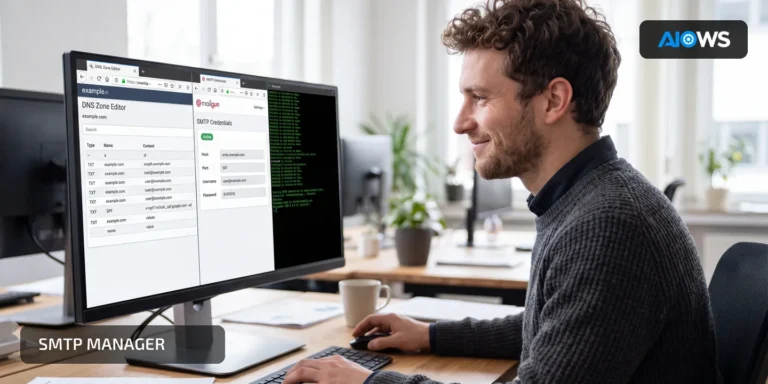
AIOWS SMTP Manager keeps the active WordPress mail configuration and controlled tests in one place. It can help verify that the chosen Google route authenticates and that a real WordPress-generated message reaches the provider.
Enter only the method approved for the account and keep one active route during acceptance. Test password resets, forms, and order mail rather than relying on a generic test message. Record the sender account and organizational team responsible for renewal or revocation.
AIOWS does not decide Google policy, create an OAuth project, grant scopes, or recover a Google account. Those remain Google Workspace and organizational security tasks. Remove temporary credentials and restore the last approved route if authentication or ownership cannot be verified.
Related AIOWS articles
- Gmail SMTP WordPress OAuth: Secure Setup Guide
- SMTP Ports 25, 465 and 587: Which One Should WordPress Use?
- How to Configure Google Workspace SMTP for WordPress
Conclusion and recommended route
The recommended route is to choose by current Google policy, least privilege, ownership and revocation. Whichever method is approved, give it one site, protected storage, a named maintainer and a rehearsed removal path; do not keep a hidden fallback.