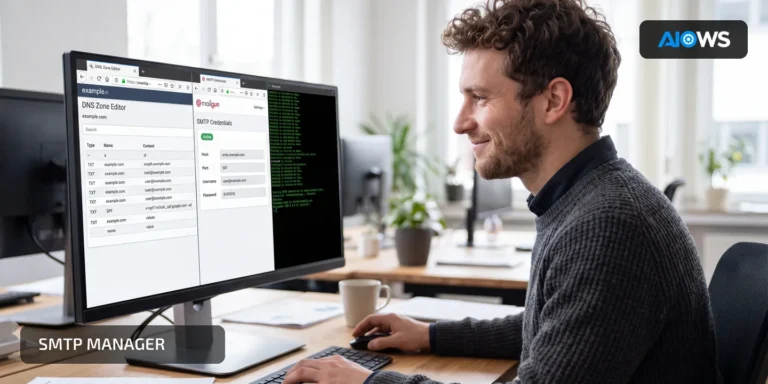

The SMTP test passes, yet a customer never receives the processing-order email. Changing mail credentials at this point can make matters worse: WooCommerce may never have generated the notification in the first place.
Start with the order event, prove that the expected email class ran, and only then trace the resulting message through WordPress, the provider, and the recipient mailbox.
What it means
WooCommerce emails are transactional notifications tied to specific events. A new order, payment confirmation, status change, refund, or account action selects a particular email type and recipient. WooCommerce must enable and build that message before WordPress can pass it to SMTP.
Trigger, generation, transport, and delivery are separate stages. A successful generic test covers only the transport stage; it says nothing about the order status, notification setting, template, or scheduled action that precedes it.
A realistic WordPress example
A card payment appears incomplete, so the order remains Pending payment. The store owner expects the customer’s processing-order email, but that notification is normally tied to the transition into Processing. No corresponding mail event appears in WordPress.
Once the payment callback is repaired, a controlled order reaches the intended status and WooCommerce creates the message. The administrator then follows its timestamp and provider ID to the test customer’s inbox instead of changing the SMTP connection.
Why it matters and when to use it
Missing order mail can affect payment instructions, fulfilment, refunds, password setup, or staff awareness. Diagnosing the wrong layer may also change order state, inventory, or customer communication without fixing the cause.
Each email type has its own enablement, recipient, and trigger. Staff notifications and customer notifications therefore need separate tests. Extensions, custom statuses, payment webhooks, Action Scheduler jobs, and template overrides can all alter the expected sequence.
Use this workflow when a defined WooCommerce notification is missing. If WooCommerce produces the message and the provider accepts it, move on to sender authentication, reputation, and mailbox filtering.
A straightforward route for beginners
- Create a controlled test order with synthetic customer details. Note its order number and the email type you expect.
- Check the status history, payment result, and order notes. Confirm that the documented trigger actually occurred.
- In WooCommerce email settings, verify that the notification is enabled and that its recipient is correct. Review template overrides only after generation is in doubt.
- Match the trigger time to WooCommerce logs, scheduled actions, PHP errors, and the WordPress mail record.
- If a message was generated, follow its SMTP response and provider identifier to a controlled inbox. Test staff and customer emails independently.
The advanced route
For a single order, map the status transition and notification class to the relevant WooCommerce hook. Check whether custom code removes or replaces callbacks, whether Action Scheduler is overdue, and whether an outdated template override raises a PHP error during rendering.
When no WordPress mail event exists, stay within WooCommerce. When wp_mail()fails, use the recorded transport error. When the provider returns an acceptance ID, investigate downstream delivery rather than regenerating the order notification.
A useful record includes the sanitized order ID, status transition, notification type, enabled state, recipient, template version, scheduled-action result, WordPress mail outcome, provider ID, and mailbox result.
Risks, common mistakes, backup, and rollback
Repeatedly changing a real order’s status can send duplicate messages, alter stock, or trigger payment and fulfilment integrations. Never expose customer addresses, order contents, or payment data in shared diagnostics. Use a dedicated test order whenever possible.
Back up notification settings, template overrides, and relevant custom code before editing them. If a change affects order handling or another email type, restore that component and leave the proven SMTP route untouched. Confirm the expected order state as well as the email.
How AIOWS helps:
AIOWS SMTP Manager
AIOWS SMTP Manager becomes relevant after WooCommerce has created a message. It keeps the WordPress-side SMTP route and sender settings consistent, so a known-good transport does not drift while order triggers, templates, and recipients are checked.
For a generated WooCommerce notification, the module’s test and diagnostic context can help confirm the handoff to the provider and the returned response. Correlate that result with the order timestamp, then verify delivery in the intended staff or customer mailbox.
The module cannot change WooCommerce order transitions, repair a payment webhook, restore missing notification hooks or callbacks, or correct a template override. Those remain application-level tasks. AIOWS helps distinguish them from a genuine SMTP failure without claiming that a test email proves the whole order workflow.
Related AIOWS articles
- WordPress Not Sending Emails: Causes and Fixes
- WordPress Test Email Works but Contact Forms Do Not Send
- WordPress Password Reset Email Not Sending: Fix It
Conclusion and recommended route
Begin with one controlled order and the exact notification it should produce. Prove the status transition and message generation before touching SMTP, then trace the resulting email to its real destination while protecting customer data.